
Whitepaper
Performance Comparison of the Spark UHPLC System Using Clinical Samples
Overview
Liquid chromatography platforms play a critical role in clinical laboratories, where analytical robustness, peak integrity, and quantitative accuracy directly influence diagnostic decision making. In this study, the Spark LC system was benchmarked against a widely used UHPLC platform (Vendor A) using methylmalonic acid as a representative biomarker. Patient samples were analyzed in parallel on both systems using columns with identical stationary phase chemistry to ensure a controlled comparison. Chromatographic evaluation showed that both systems produced highly comparable chromatograms, with only minor differences in peak characteristics. Quantitative assessment using Passing–Bablok regression demonstrated excellent agreement between the platforms, yielding a slope of 0.999 (95% CI: 0.993–1.01) and an intercept of –0.317 (95% CI: –1.66–0.818), indicating no significant proportional or systematic bias. These results confirm the analytical equivalence of the Spark LC system to established UHPLC technology and support its suitability for routine clinical biomarker quantification.
Methylmalonic Acid: Clinical Relevance and Analytical Demands
Methylmalonic acid (MMA) is a clinically relevant biomarker for assessing vitamin B12 deficiency, as impaired vitamin B12–dependent metabolism leads to elevated MMA concentrations in blood and urine. Because MMA levels directly inform diagnostic interpretation and patient management, accurate and consistentquantification is essential in a clinical setting (1).
From an analytical perspective, MMA presents several challenges. Its typically low physiological concentration requires highly sensitive detection, while reproducibility and chromatographic stability are critical for generating reliable results (2).
UHPLC systems used in clinical laboratories must therefore deliver uniform injections, robust signal quality, and stable separations under routine operating conditions.
To evaluate whether the Spark LC system meets these requirements, the University Medical Center Groningen (UMCG) conducted a direct comparison with a widely used UHPLC platform from Vendor A. Patient samples were injected in parallel on both systems using columns with identical stationary‑phase chemistry, enabling a controlled assessment of chromatographic behavior and quantitative agreement under real‑world conditions.
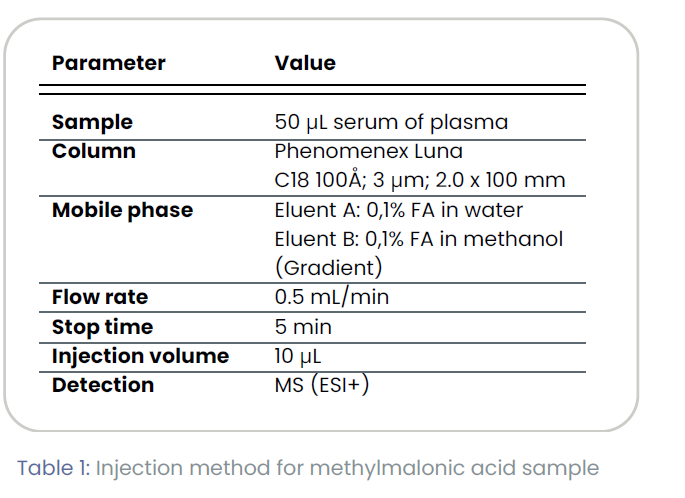
The results of this evaluation are presented in the following sections, focusing on peak‑shape characteristics, chromatographic integrity, and quantitative agreement between the two systems. The overarching aim is to determine whether the Spark LC system performs equivalently to the established UHPLC platform in a clinical diagnostic workflow.
Comparative Performance Analysis Based on Peak Morphology and Passing-Bablok Regression
Analytical performance was compared with a high‑end UHPLC system commonly used in clinical laboratories (Vendor A). Figure 1 provides an objective overlay of chromatograms obtained on both platforms. The two systems showed comparable retention times and peak areas, and the overall chromatographic profiles were similar. Minor differences in peak width and symmetry were visible, with the Spark LC system exhibiting a slightly narrower and more symmetrical peak.
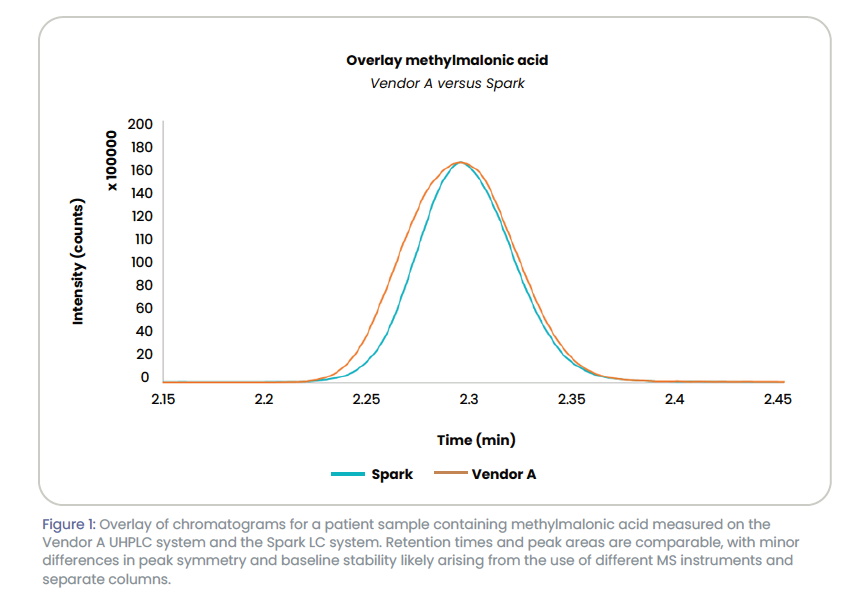
A direct one‑to‑one comparison is challenging, because the measurements were performed using two separate but chemically identical columns and two different mass spectrometers of the same make and model.
These differences in hardware configuration introduce unavoidable variation in dispersion, detector response, and column performance. It is therefore not possible to attribute the observed peak‑shape differences solely to the LC systems themselves.
Despite these limitations, the chromatographic behavior across platforms remained consistent, and the quantitative agreement between systems was further supported by Passing–Bablok regression (Figure 2). This indicates that, within the constraints of the available data, both systems provide comparable analytical performance for the measurement of methylmalonic acid. Peaks were normalized to facilitate consistent morphological evaluation.
Calibration curves were generated across a clinically relevant concentration range and evaluated using Passing–Bablok regression, a robust non‑parametric method widely applied in clinical chemistry for method‑comparison studies. This approach provides unbiased estimates of proportional (slope) and systematic (intercept) differences between measurement systems and remains resilient to outliers and non‑normal error distributions.
The regression analysis demonstrated excellent agreement between the Spark LC system and Vendor A (Figure 2). The resulting model, y = –0.317 + 0.999x, yielded a slope of 0.999 (95% CI: 0.993–1.01) and an intercept of –0.317 (95% CI: –1.66–0.818), indicating no significant proportional or systematic bias across the tested concentration range.
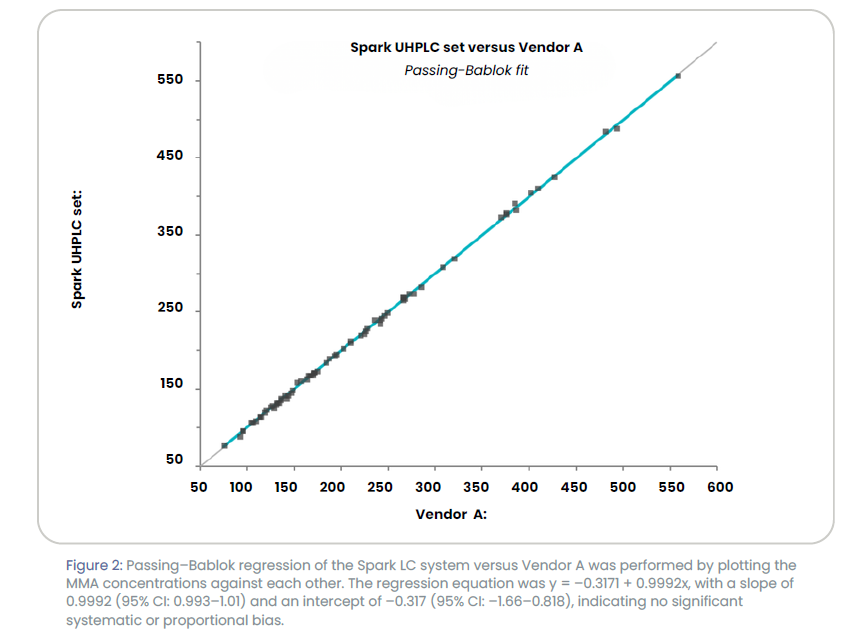
These findings were further supported by strong linearity and reproducibility, with repeated injections maintaining stable performance over extended runs.
Together, the chromatographic observations and statistical agreement confirm that the Spark LC system delivers analytical performance equivalent to the benchmark UHPLC platform. The system achieves this while providing practical advantages in automation and workflow reliability, reinforcing its suitability for routine clinical biomarker quantification.
Conclusion
The comparative assessment of methylmalonic acid quantification shows that the Spark LC system delivers analytical performance equivalent to that of a widely used UHPLC platform in a clinical diagnostic workflow. Chromatographic profiles from both systems were closely aligned, with only minor peak‑shape differences likely related to the use of different mass spectrometers and separate, though identical columns. These small variations did not affect the overall interpretation of chromatographic behavior.
Passing–Bablok regression further confirmed the strong agreement between platforms, demonstrating no significant proportional or systematic bias across the clinically relevant concentration range. The observed linearity, reproducibility, and stability across repeated injections underscore the robustness of the Spark LC system under routine operating conditions.
Together, these findings support the Spark LC system as a reliable and clinically suitable alternative to established UHPLC technology for routine biomarker quantification.
Acknowledgements
Spark Holland thanks the staff of the University Medical Center Groningen (UMCG) for their collaboration and for contributing their time and expertise to this laboratory evaluation.
References
1.Dharmarajan TS, Norkus EP. Approaches to vitamin B12 deficiency. Early treatment may prevent devastating complications. Postgrad Med. 2001 Jul;110(1):99-105; quiz 106. doi:10.3810/pgm.2001.07.977. PMID: 11467046
2.Nelson D, Xu N, Carlson J. Semi-automated quantification of methylmalonic acid in human serum by LC-MS/MS. Scand J Clin Lab Invest. 2012 Oct;72(6):441-6. doi: 10.3109/00365513.2012.679963. Epub 2012 Aug30. PMID: 22935047.
Click the button to download